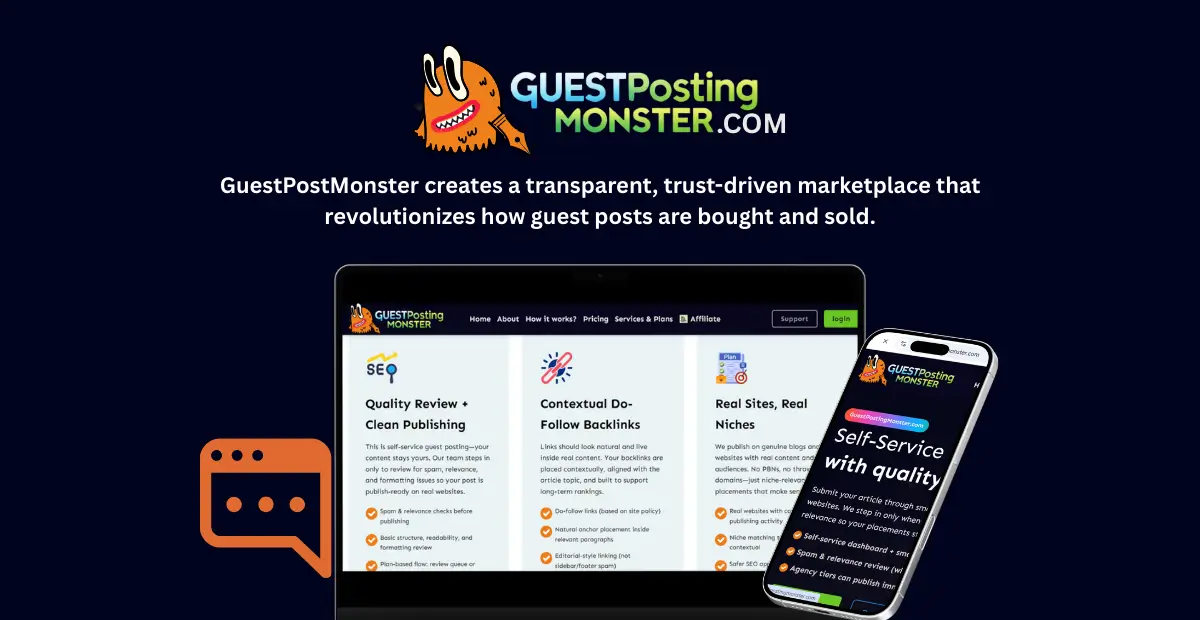
GuestPostingMonster makes the world of guest posting, which has always been difficult to understand, clear and easy to use. It gets rid of the secrecy, price differences, and uncertainty about quality that have been problems in the industry for a long time. The platform replaces guesswork with trust by connecting publishers and marketers through verifiable metrics, standardized listings, and a dual-sided reputation system. This creates a fair and long-lasting ecosystem for high-quality link building and content partnerships.
How GuestPostingMonster Makes the Market for Buying and Selling Guest Post Opportunities Clear
By creating a clear and trustworthy marketplace for buying and selling guest post opportunities, GuestPostingMonster has entirely changed the way digital link-building works. This platform brings a level of clarity and fairness to a world that has always been secretive, with prices that aren’t always the same and quality that isn’t always reliable. The service is good for both publishers who want to make money from their sites and content marketers who want to build high-quality, authoritative backlinks. GuestPostingMonster uses market principles to make a process that is usually hard to see more fair and efficient for everyone involved.
The Unclear History of Guest Post Deals
For years, getting a guest post spot on a relevant, well-known blog was like trying to find your way through a maze without being able to see. Blog owners and site publishers often didn’t have a clear way to figure out how much their digital real estate was worth. Rates were random and based on gut feeling or what the market might be able to handle in a one-time deal. On the other hand, SEOs and content marketers wasted a lot of time reaching out to people, only to get no response or very high, unexplained prices. The absence of a central, standardized platform led to inconsistency, frustration, and even bad behavior.
This lack of transparency wasn’t just annoying; it also hurt trust. Marketers weren’t always sure if they were getting a favorable deal on a link’s real value. They often wondered if the site’s traffic and domain authority were real. Publishers, on the other hand, risked undervaluing their assets or getting low-quality, spammy content that could hurt their site’s reputation and search rankings.
There was a real human cost: talented writers lost interest in outreach, and dedicated site owners lost out on real ways to make money. GuestPostingMonster didn’t just come out as another tool; it was a necessary fix for this systemic problem, replacing guesswork with data and one-sided negotiations with mutual respect.
Making the Guest Posting Monster Marketplace Model Clear
GuestPostingMonster is based on a simple but powerful idea: make a central, open platform where publishers with guest post opportunities and marketers looking for quality backlinks can meet under clear, standard terms. This model gets rid of the problems and uncertainties that have been in the industry for a long time. It’s not a secret network or a closed directory; it’s an open market where value is based on what people can see and agree on.
The platform is brilliant because it turns what used to be a messy process into a structured one. The platform clarifies all the factors influencing the value of a guest post, enabling both parties to make informed decisions. The marketplace’s trustworthiness stems from this transparency.
How Every Transaction is Made More Open
Transparency isn’t just a buzzword here; it’s the way we do business. For a marketplace that deals with a product as complicated as a guest post, this means making the things that aren’t there clear.
First, set standard criteria for vetting and listing. Publishers who want to list their sites on GuestPostingMonster must give proof of their information. This isn’t just fluff that people say. For every listing, important information like Domain Rating (DR), Ahrefs Traffic, niche category, and content guidelines is easy to find.
A marketer can quickly tell if a site in the “Digital Marketing” niche has a DR of 45 and 10,000 organic visitors per month, as well as what the publisher wants in terms of content quality and linking. This eliminates the need for “black box” negotiations, which typically conceal these details until the conclusion of the process.
Second, prices that are clear and upfront. There is a price listed for each listing. Some high-end sites may require direct negotiation, but most of them use a fixed-price model. This one thing is a game changer. Marketers can plan their budgets well without worrying about price increases after spending time writing a pitch. Publishers set a price that reflects how valuable their site is, and they know that buyers will understand that value. No more awkwardly asking, “What’s your budget?” or “How much do you charge?”
The Two-Sided Reputation System That Makes Trust Possible
Trust is necessary for a market to be open. GuestPostingMonster doesn’t make promises; instead, it builds this with a strong, two-sided reputation system like the ones used by eBay or Airbnb, but made for content.
Sellers’ (publishers’) reputations are based on their site’s verified metrics and their platform performance. Do they get back to you quickly? Do they give clear rules for how to write? Most importantly, do they publish content that people send them on time and without changing links without permission? Their history on the platform is a public record of how reliable they are.
For buyers (marketers and content creators), reputation is based on how excellent the content they submit is. Publishers can give buyers a score. Are they writing well-researched, original articles that fit with the site’s audience? Or are they just sending in junk with a lot of keywords in it to get a link? A marketer with a high rating is a valuable partner who is likely to get approvals faster and maybe even invitations from top publishers.
This system makes a strong way for people to police themselves. Reviews and ratings swiftly reveal the bad actors on both sides, promoting community health. It encourages everyone to act professionally, which improves the whole market.
A Strategist’s Guide to Getting the Most Out of GuestPostingMonster
Buying a guest post is not a plan. As a senior SEO, you should treat the GuestPostingMonster marketplace like a stock market. To succeed, you must research, diversify, and monitor your investments. Here is a step-by-step plan that I use and suggest.
Step 1: Set your goals for link assets.
Are you trying to get your brand known in a new market? Targeting a specific business keyword with anchor text that matches exactly? Or making a base of topical relevance with a group of links that support it? The goal you set for yourself will determine all of your search criteria on the platform. A brand-building campaign might focus on sites with a lot of traffic and social interaction, while a keyword push looks for strong DR in a very specific niche.
Step 2: Apply advanced filtering with extreme precision
The filters on the platform are your most powerful tool. Get more than just “DR” and “Price.”
Traffic Value and Keywords: Find sites where the traffic matches the people you want to reach. A site that has a low Domain Rating (DR) but receives significant traffic for specific, relevant mid-funnel keywords may be more valuable than a high-DR site that attracts a lot of traffic but is not very useful.
Relevance to your niche: This is a must-have for SEO value. Google’s algorithms excel at identifying related topics. A link from a site that is very relevant to your topic sends stronger signals of “link equity” and relevance than one from a generic “news” site.
Read the content guidelines cautiously: Some websites don’t allow commercial anchor text at all. Some people have very strict rules about how things should look. Not following the rules is the quickest way to get turned down and hurt your buyer rating.
Step 3: The Content-for-Asset Exchange
This is where you do it. Your guest post is what you use to buy a link asset. The content you give the publisher must be worth more to their readers than the link is to you. This means that
Providing Unique Data or Insights: Are you able to do a short survey, look at a public dataset, or share an intriguing case study from your work?
Solving a Clear Problem: Write a detailed, step-by-step guide that helps the publisher’s readers with a problem that keeps coming up.
Professional Presentation: Send in a perfect copy with the right formatting, suggested images (with licenses), and clear requests for where to put links that make sense in the context.
Step 4: Keeping track of your portfolio and reviewing your performance
Make a spreadsheet that keeps track of each purchase, including the site DR/DA, price, target URL, anchor text used, and date published. Keep an eye on your target keywords to see if they change. Check Google Search Console to see if the linked page is getting more clicks and views. This information will help you make better purchases in the future by showing you which kinds of sites (like high-traffic vs. high-DR or interview-style vs. tutorial-style) give you the best return on investment for your specific goals.
The Mistakes to Avoid, Even on a Clear Platform
Even with a clear tool, an unskilled strategist can still make bad choices. Here are the most common mistakes I see and how to avoid them.
Mistake 1: Only going after Domain Rating (DR). This is the worst thing you can do. It’s not smart or safe to buy links just because they have the highest DR you can afford. A DR 80 site about gardening won’t help your FinTech startup and might even confuse Google about what it is about. The Correction: Put niche relevance above everything else. A DR 35 site that is a well-known expert in your field is worth a lot more than a DR 80 generic site.
Mistake 2: Not paying attention to the publisher’s audience. You are writing for other people’s readers, not your own. If you send in an article that is full of products and sales pitches but doesn’t really add anything, it will be rejected or, worse, published to an audience that doesn’t care or is hostile, wasting your link asset. The Fix: Before you write anything, spend 30 minutes on the site you want to target. Look at the comments. Know the tone, style, and what issues are important to the audience. Make sure your content fits.
Mistake 3: Not managing anchor text well. Over-optimization is a sign that something is wrong. It’s not safe or smart to use the same exact-match commercial keyword anchor text in every guest post you buy. The Fix: Use a natural, varied anchor text profile. Use brand names, URLs, neutral phrases like “according to this study” and “learn more here,” and long-tail keywords that describe what you’re looking for. The link should look and sound like a normal recommendation from an editor.
Mistake 4: Thinking of it as a one-time thing instead of a relationship. The best users see each transaction as the start of a partnership. A one-and-done approach leaves money on the table. The Correction: After it comes out, get involved. Post the article on your brand’s social media pages. Say thanks to the editor. If the post does well for them, they may be able to work together again in the future, potentially at a better rate or with better linking terms.
Real-World Applications: How Brands Use the Marketplace
Case Study 1: The B2B SaaS Startup Scaling Authority
A SaaS company that was competing in the project management space needed to build topical authority for terms like “remote team collaboration.” Their in-house team was too busy with product work to do it. They used GuestPostingMonster to find sites in the “Business Software,” “Remote Work,” and “Productivity” niches that had a DR of 40 to 60 and a lot of organic traffic.
- They didn’t use direct “best software” lists as a strategy. Instead, they pitched and published data-driven articles like “The Impact of Async Communication on Project Timelines” and “A Framework for Reducing Meeting Overload in Distributed Teams.”
- Execution: Each piece had one link back to a relevant, in-depth blog post on their site about a specific feature that fixed the problem that was being talked about.
- Result: They got 15 favorable guest posts in just six months. The linked pages got 22% more organic traffic, and they started to rank on page 2 for a number of competitive mid-funnel keywords. This made them a thought leader, not just a vendor.
Case Study 2: The E-commerce Brand That Got a Fine and Got Better
A brand that makes outdoor clothing got a manual penalty years ago because of negative backlinks. After disavowing, they needed a clean, white-hat link-building plan to get back on track. They used GuestPostingMonster to locate publishers in the “Outdoor Adventure,” “Hiking,” and “Sustainable Fashion” categories.
- Focus on storytelling and expertise as part of your strategy. Their head of product design wrote about “The Evolution of Breathable Waterproof Fabrics,” and their head of sustainability wrote about “Ethical Sourcing in the Outdoor Industry.”
- Execution: They only used brand-name and URL anchors, and there was a clear author bio that linked to their site. The content was really educational, which got many people to visit the publisher sites.
- Result: This clean, authoritative link profile, along with other efforts, was a big reason why Google put their site back up. More importantly, referral traffic from these authoritative niches went up, which brought them directly to their ideal customers.
The Future of Clear Link Building and Changes in the Market
GuestPostingMonster’s model is not the end; it’s the start of a more advanced stage in digital PR and SEO. We can expect a few significant changes.
Adding more in-depth quality metrics. In addition to DR and traffic, future marketplaces will probably use metrics like “E-E-A-T scores,” which are based on the publisher’s expertise and the author’s credentials, or “reader engagement scores,” which look at how long people spend on a page, how many comments they leave, and how many times they share it on social media. This will make it easier to tell the difference between sites that are really authoritative and those that have just played with link-based metrics.
The Rise of Pricing Based on Performance. We might see experiments with hybrid models, even though fixed pricing is stable. A small fee up front and a bonus for a post that brings in a certain number of leads or conversions could make the incentives even more closely aligned. Such an arrangement changes the deal from “buying a link” to “putting money into a marketing channel.”
Platforms as places to work together on content. The next step is to make it easier not just to buy something but also to make it. Within the platform’s ecosystem, we might see built-in tools for quick collaboration, content outlines, revision workflows, and even vetted networks of freelance writers who specialize in certain areas. Such initiatives would make things even easier and help the space become more professional.
Smart marketers should learn to be okay with this level of openness. People will start to judge your strategy less on how many links you get in the shadows and more on how well you build relationships and how much real value you give and get in the open.
Accepting the New Standard for Guest Posting
The time of guessing and keeping things secret in guest posting is over. GuestPostingMonster has shown that a clear, well-organized marketplace is good for everyone: publishers get fair value for their work, and marketers get high-quality link assets that they can count on. It’s not about making link building easier; it’s about making it professional, scalable, and based on real value exchange. The end-user is the real winner in this new world because they can find better content on the web, written by real experts and hosted on sites that are relevant and trustworthy. For the strategic SEO and content marketer, mastering this open market is no longer an option; it’s a basic skill they need to build long-lasting, penalty-proof online authority in the years to come.