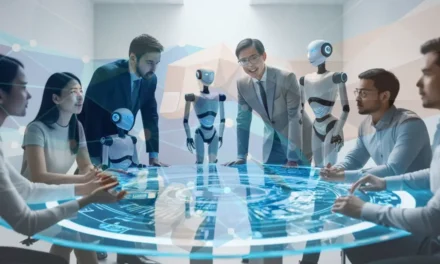

We stand at the precipice of a new era, not defined by a single gadget or software update, but by a fundamental shift in the very fabric of our systems. You are already interacting with it, likely without a second thought. Artificial Intelligence (AI) is no longer a speculative frontier; it is the dynamic, beating heart of modern innovation. This pervasive Intelligent Technology is moving from the periphery to the absolute Core of every industry, process, and creative endeavor. It’s not just about automating tasks; it’s about augmenting human potential, solving grand-scale challenges, and architecting a smarter, more responsive Tomorrow. To understand this transformation is to understand the future being built around us, right now.
Opening Insight: The Silent Symphony of Intelligence
There’s a quiet revolution happening. It doesn’t always roar with the fanfare of a rocket launch; more often, it whispers in the precision of a medical diagnosis, the uncanny relevance of a music recommendation, or the seamless flow of city traffic at dawn. This revolution is the embedding of Intelligent Technology into the mundane and the monumental alike. For decades, AI lived in research labs and science fiction. Today, it’s the invisible hand guiding logistics networks that deliver your groceries, the pattern-recognizing eye scanning satellite imagery for climate changes, and the linguistic model helping a writer overcome a block. The importance of this shift cannot be overstated. It’s emotional because it touches human aspirations—the hope for longer, healthier lives, the desire for creative liberation from drudgery, the universal need for safer, more efficient communities. We are not merely using tools; we are collaborating with a new form of operational intelligence, learning to partner with systems that can see, predict, and optimize in ways we alone cannot.
Core Concepts Explained Clearly
At its essence, AI at the Core signifies a transition from AI as a standalone application (a chatbot on a website) to AI as the foundational operating system for entire enterprises and societal functions. It’s the difference between having a calculator and living inside a dynamically learning, calculating universe.
2.1: From Automation to Augmentation: The Paradigm Shift
The first wave of digital technology was about automation—programming machines to execute repetitive, rules-based tasks. Intelligent Technology introduces augmentation. Think of a radiologist using an AI diagnostic assistant. The AI doesn’t replace the doctor; it rapidly pre-scans thousands of images, highlights areas of potential concern with superhuman consistency, and presents its findings. The radiologist then applies their years of training, contextual knowledge, and human judgment to the final diagnosis. The outcome is faster, more accurate, and less fatiguing for the expert. The core concept here is synergy. The AI handles scale, speed, and pattern recognition across vast datasets. The human provides ethics, empathy, strategic oversight, and creative problem-solving. This symbiotic relationship is where the true power lies.
2.2: The Architectural Pillars: Data, Algorithms, and Compute Power
For AI to function at the core, three pillars must be structurally sound. First, Data is the new lifeblood. Not just big data, but clean, relevant, and ethically sourced data. An AI model is only as insightful as the data it learns from. Second, Algorithms are the recipes. Breakthroughs in machine learning, particularly deep learning and neural networks, have enabled machines to learn from data in layered, complex ways similar to the human brain. Finally, Compute Power—specifically, advanced GPUs and cloud computing infrastructures—provides the immense processing muscle required to train these models. It’s the confluence of these three elements, now more accessible than ever, that has moved AI from theory to core infrastructure.
Strategies for Integrating Intelligent Technology at the Core
For organizations and individuals, navigating this shift requires intentional strategy, not just adoption of shiny tools.
1. Problem-First, Not Technology-First:
The most common error is starting with the AI solution and seeking a problem. The winning strategy is inverted. Begin with a critical business or operational pain point. Is it predictive maintenance on manufacturing lines reducing downtime? Is it hyper-personalizing customer journeys to improve retention? Define the problem with extreme clarity, measure its current cost, and then evaluate if AI is the right lens to solve it.
2. Cultivate a Data-Centric Culture:
Integration fails without data readiness. This means:
-
Auditing Your Data Assets: What do you have? Where is it? Is it structured or unstructured?
-
Establishing Governance: Implement strict protocols for data quality, privacy (adhering to regulations like GDPR), and security.
-
Breaking Down Silos: Encourage data sharing across departments. The most potent AI insights often come from connecting disparate data sources—sales data with supply chain logistics, for instance.
3. Build, Partner, or Buy with Clarity:
You don’t need to build a massive AI lab in-house.
-
Build core models only if AI is your primary product differentiator (e.g., a proprietary recommendation engine).
-
Partner with specialized AI firms or cloud providers (like AWS, Google Cloud, Azure) for their pre-built tools and expertise for complex, non-core challenges.
-
Buy off-the-shelf SaaS AI tools for common functions like CRM analytics, content optimization, or customer service chatbots.
4. Prioritize Ethical AI and Human-in-the-Loop (HITL) Design:
Build trust from the start. Design systems where humans have meaningful oversight. Create clear protocols for auditing AI decisions for bias, ensuring transparency where possible (explainable AI), and maintaining ultimate human accountability, especially for high-stakes decisions in finance, healthcare, or justice.
Common Mistakes and How to Avoid Them
-
Mistake: The “Set and Forget” Fallacy. Deploying an AI model and assuming it will perform perfectly forever.
-
Why It Hurts: AI models can “drift.” As real-world data changes, the model’s performance degrades, leading to inaccurate, costly, or even harmful outputs.
-
Correction: Implement a robust MLOps (Machine Learning Operations) pipeline. Continuously monitor model performance, retrain with new data at regular intervals, and have a rollback plan.
-
-
Mistake: Neglecting Change Management. Forcing new AI tools on employees without context or training.
-
Why It Hurts: It fosters resistance, fear, and poor adoption. Employees may see AI as a threat, not a partner, leading to sabotage-by-disuse.
-
Correction: Communicate transparently about the “why.” Involve teams early in the design process. Focus training on upskilling—how AI will make their jobs more impactful by removing tedium—not replacing.
-
-
Mistake: Chasing Novelty Over ROI. Investing in cutting-edge, complex AI for marginal gains.
-
Why It Hurts: Wastes resources, creates technical debt, and disillusion stakeholders about AI’s real value.
-
Correction: Ruthlessly tie every AI initiative to a Key Performance Indicator (KPI). Start with low-hanging fruit projects that have clear, measurable returns (e.g., AI-driven inventory reduction, chatbot deflection rate) to build credibility and fund more ambitious projects.
-
Case Studies: Intelligent Technology in the Wild
1. Modern Agriculture: John Deere’s Self-Optimizing Farms
John Deere has transformed from a machinery company to a technology company with AI at its Core. Their tractors and harvesters are now data-generating robots. Computer vision AI identifies individual weeds among crops and applies herbicide micro-doses only where needed, reducing chemical use by over 90%. Machine learning algorithms analyze soil data, weather patterns, and historical yield maps to prescribe optimal planting density and fertilizer mix for every square foot of a field. The result isn’t just automation; it’s augmented decision-making for the farmer, leading to monumental gains in sustainability and yield. This is a prime example of Intelligent Technology solving the grand challenge of feeding a growing population with fewer resources.
2. Healthcare Diagnostics: PathAI’s Augmented Pathology
PathAI develops AI-powered tools for pathologists. In diagnosing diseases like cancer from biopsy tissue samples, human pathologists face immense workloads and the natural variability of human judgment. PathAI’s platform uses deep learning to analyze digital pathology images. In real-world studies, these tools have been shown to help pathologists detect cancer metastases more accurately and consistently. The AI doesn’t diagnose; it flags regions of interest and provides quantitative data. This allows the expert pathologist to work faster and with greater confidence, reducing diagnostic errors and getting patients on treatment plans sooner. It demonstrates the core-to-core integration of AI in a critical, human-centric field.
3. Urban Mobility: Google’s Project Green Light for Traffic Flow
This is a subtle but powerful application. Google uses AI models built from aggregated, anonymized Maps data to optimize traffic light timing in cities. Their AI analyzes traffic patterns at intersections—vehicle speed, stop-and-go frequency, queue length—and simulates millions of tuning scenarios. It then provides city traffic engineers with recommendations for simple adjustments to the existing light timing plans. Early pilots in cities like Seattle and Hamburg have shown a reduction in stop-and-go traffic by up to 30% at intersections, directly cutting emissions and fuel consumption. This showcases how Intelligent Technology, deployed through existing infrastructure, can create a smarter Tomorrow for entire urban populations.
Advanced Insights: The Evolving Frontiers and Inevitable Challenges
Looking ahead, the integration will deepen. We’re moving toward Agentic AI—systems that don’t just analyze or recommend but independently execute multi-step tasks (e.g., an AI that can plan a full marketing campaign, draft copy, design assets, and schedule posts based on a single goal). The fusion of AI with robotics (embodied AI) and the rise of generative models for creating synthetic data will accelerate innovation in physical-world domains like manufacturing and drug discovery.
However, the horizon is not without clouds. The Energy Dilemma looms large: training massive AI models consumes vast amounts of electricity. Sustainable, green compute will become a critical competitive and ethical imperative. Regulatory Scrutiny will intensify, shaping what data can be used and how decisions can be made. The most successful organizations will be those that view ethical, efficient AI not as a compliance cost but as a foundational component of their brand trust and operational resilience. The next battleground won’t be who has the most AI, but who has the most trustworthy, effective, and sustainable AI.
Final Takeaway
The narrative has irrevocably shifted. Artificial Intelligence is no longer a destination on the horizon; it is the engine in the vessel carrying us forward. To view it as merely a tool is to miss the profound transformation. Intelligent Technology, when placed at the Core, redefines possibility. It asks us to reimagine our roles, to partner with silicon-based intuition, and to steer this powerful force toward outcomes that amplify our humanity—better health, a healthier planet, unleashed creativity, and more meaningful work. The Tomorrow being powered is not a passive future we await, but an active construction site. The blueprint is written in code and algorithms, but the vision, the ethics, and the ultimate goals must be unmistakably, brilliantly human. The question is no longer if AI will be at the core, but how wisely we will build upon it.