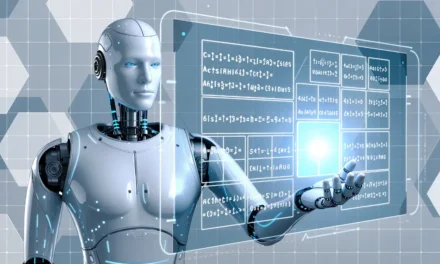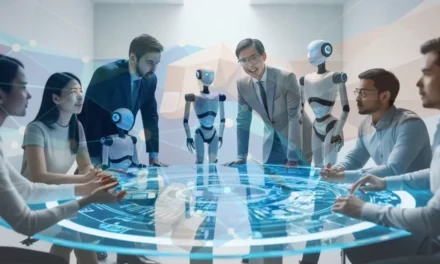

We are living through The New Age of AI, a transformative era where intelligent systems are evolving from simple tools into collaborative partners, reshaping industries and redefining human potential with a Bigger Impact than any technological wave before it. This new epoch is not about isolated algorithms but interconnected, reasoning systems that learn, adapt, and integrate seamlessly into the fabric of our work and daily lives, promising seismic shifts in productivity, creativity, and problem-solving on a global scale.
Opening Insight: Beyond Automation to Augmentation
The story of AI is no longer one of cold, impersonal machines taking over repetitive tasks. That was the prologue. The central narrative of this New Age of AI is one of profound augmentation—a partnership where AI amplifies human intelligence, creativity, and decision-making. The emotional core of this shift is a blend of awe and necessary adaptation. Consider the medical researcher who can now cross-reference millions of genomic datasets in minutes, finding patterns invisible to the human eye, to pinpoint a potential therapy for a rare disease. Or the small business owner using AI to craft personalized marketing campaigns that rival those of multinational corporations. The human connection here is empowerment. The fear of replacement is giving way to the excitement of elevation, but only for those willing to engage deeply and ethically with these Smarter Systems. This transition demands a new literacy, not just in using AI tools, but in understanding their logic, their biases, and their appropriate place in our workflows. The importance lies in navigating this shift thoughtfully, ensuring the Bigger Impact is one of shared prosperity and solved grand challenges, not widened gaps.
Core Concepts Explained Clearly
To move beyond the hype, we must ground our understanding in the key paradigms powering this new age. The leap from the previous generation of AI to today’s Smarter Systems is defined by fundamental advancements in capability and application.
The old paradigm was largely about pattern recognition within narrow domains—identifying a cat in a photo, transcribing speech to text. Today’s systems exhibit facets of reasoning, contextual understanding, and generative creation. They don’t just analyze data; they synthesize new content, suggest novel strategies, and operate across multiple modalities (text, image, code, audio) simultaneously. This shift from analytical to generative and agentic AI is the engine of the current revolution. The real-world relevance is immediate: a designer can now iteratively brainstorm with an AI on visual concepts; a software developer can describe a function in plain English and have the first draft of the code written; a supply chain manager can simulate countless disruption scenarios to build resilience.
The Pillars of Modern AI: Foundation Models and Agentic Workflows
At the heart of Smarter Systems are foundation models—vast neural networks trained on enormous datasets that can be adapted (fine-tuned) to a wide range of tasks. Think of them as a broadly knowledgeable base layer of intelligence. A single model can power a customer service chatbot, draft legal documents, and explain complex scientific concepts. This versatility breaks down silos. The practical implication for businesses is staggering: instead of building dozens of separate, single-purpose AI tools, they can leverage one core, adaptable intelligence tailored to various departmental needs, ensuring consistency and reducing development overhead.
The second pillar is the move toward agentic workflows. An AI agent isn’t just a tool you query; it’s a system that can be given a high-level goal (e.g., “Plan a complete product launch campaign”) and then autonomously break it down into sub-tasks: conduct market research, draft copy for ads, design banner images, schedule social media posts, and compile a report. It uses reasoning, memory, and access to tools (web browsers, design software, calendars) to execute. This transforms AI from a passive resource into an active, managing partner.
From Data Analysis to Co-Creation: The Generative Leap
The most tangible sign of the New Age of AI is generative AI. This isn’t just about creating pretty pictures. It’s about the acceleration of the ideation-to-creation pipeline across all knowledge work. In engineering, generative design AI can produce thousands of viable component prototypes that meet specific strength, weight, and material constraints. In pharmaceuticals, it can generate molecular structures for new drugs. In content, it assists writers by suggesting narrative structures, overcoming creative block, and personalizing messaging at scale.
The key insight is that these systems are not oracles but collaborators. Their output is a starting point—a first draft that requires human judgment, ethical review, and strategic direction. The Bigger Impact comes from the symbiotic cycle: human expertise guides the AI, and the AI expands the possibilities of human expertise, creating a feedback loop of escalating capability. This shifts the competitive advantage from those with the most data to those with the best judgment and most creative prompts—the ability to ask the right questions and critically evaluate the answers.
Strategic Integration: A Framework for Harnessing AI’s Impact
Adopting AI is no longer a speculative IT project; it is a core strategic imperative. Here is a practical, expert-level framework for integrating Smarter Systems to achieve a Bigger Impact.
Phase 1: Audit and Align (The “Why”)
Begin not with technology, but with ambition. Conduct a process audit across key departments (marketing, R&D, customer service, operations). Identify not just repetitive tasks, but complex knowledge work bottlenecks: strategic planning, creative brainstorming, data synthesis, personalized communication. Align potential AI applications with top-level business goals—increasing innovation velocity, improving customer lifetime value, reducing operational risk. This ensures every AI initiative is purpose-driven, not novelty-driven.
Phase 2: Build the Foundation (The “How”)
-
Data Governance: AI is only as good as the data it accesses. Clean, structured, and ethically sourced data is non-negotiable. Establish clear protocols for data quality, privacy, and security.
-
Tool Selection: Choose between large, public foundation models (for general tasks) and fine-tuned or custom models (for proprietary advantage). The decision hinges on the need for control, specificity, and data security. Often, a hybrid approach is best.
-
Skill Upskilling: Invest in prompt engineering training, but more importantly, in critical AI literacy. Every employee should understand the capabilities, limitations, and potential biases of the tools they use.
Phase 3: Implement with Iteration (The “Do”)
Start with controlled pilot projects that have clear success metrics. For example, deploy an AI agent to handle the first level of customer service inquiries, measuring resolution time, customer satisfaction, and agent workload reduction. Use a feedback-driven iteration loop: deploy, measure, learn, refine. Scale successful pilots gradually. Encourage a culture of experimentation where teams are rewarded for finding novel, productive uses for AI, fostering organic, bottom-up innovation.
Phase 4: Govern and Scale (The “Steward”)
Establish an AI ethics and governance committee. Create clear policies on responsible use, copyright compliance, output verification, and transparency. As solutions prove their value, develop a scaling plan that includes technical infrastructure, change management, and continuous learning programs. Treat AI integration as an ongoing strategic evolution, not a one-time project.
The path to AI integration is littered with avoidable mistakes that can derail projects and waste significant resources.
Mistake 1: The “Set and Forget” Fallacy. Deploying an AI system without ongoing human oversight is a recipe for disaster. AI can generate plausible but incorrect information (“hallucinate”), amplify biases in its training data, or produce outputs that drift from brand voice over time.
-
The Correction: Implement a human-in-the-loop (HITL) model for critical outputs. Establish rigorous review checkpoints. Continuously monitor performance with clear KPIs and retrain/fine-tune models with new, curated data.
Mistake 2: Chasing Novelty Over Solving Problems. Being drawn to the flashiest new AI model without a concrete business problem to solve leads to unused licenses and disillusionment.
-
The Correction: Anchor every AI investment to the Phase 1 audit. Ask: “What specific pain point does this address? How will we measure success?” If you can’t answer clearly, don’t proceed.
Mistake 3: Ignoring the Cultural and Skills Transition. Forcing new AI tools on employees without context, training, or addressing legitimate fears of job displacement leads to resistance and sabotage-by-inertia.
-
The Correction: Lead with communication. Frame AI as an augmenter, not a replacer. Provide comprehensive, role-specific training. Involve teams in the selection and testing process. Celebrate and reward early adopters who find efficiencies.
Mistake 4: Neglecting Security and Intellectual Property (IP) Risks. Feeding proprietary data into a public AI model can inadvertently make that data part of the model’s training set, leaking competitive secrets. Prompts themselves can contain sensitive information.
-
The Correction: Work closely with legal and security teams. Use enterprise-grade AI platforms with strong data privacy guarantees. Institute clear policies on what data can and cannot be used. Consider private, on-premise deployments for highly sensitive workloads.
Case Studies: The New Age of AI in Action
Case Study 1: Moderna and Accelerated Drug Discovery
During the COVID-19 pandemic, pharmaceutical giant Moderna leveraged AI at an unprecedented scale. The sequence for the SARS-CoV-2 virus was published on January 11, 2020. Just two days later, Moderna’s AI-powered design systems had finalized the sequence for its mRNA vaccine. AI was used to optimize the mRNA sequence for stability and potency, predict potential clinical trial outcomes, and streamline manufacturing logistics. This compressed a process that traditionally took years into months. The Bigger Impact here is not just speed, but the proven model for responding to future pandemics and tackling other complex diseases like cancer, fundamentally changing our approach to global health.
Case Study 2: Klarna’s AI-Powered Financial Assistant
The global fintech company Klarna deployed an AI assistant built on a foundation model to handle customer service. Within one month, it was doing the work of 700 full-time customer service agents, managing 2.3 million conversations with a customer satisfaction score on par with human agents. It is available 24/7 and speaks over 35 languages. Crucially, it resolved errands in less than 2 minutes, compared to 11 minutes previously. This is a prime example of a Smarter System creating efficiency at scale while improving the customer experience. The impact allowed Klarna to reallocate human agents to more complex, high-value customer issues, demonstrating the augmentation model in practice.
Case Study 3: Lonely Planet and Dynamic, Personalized Travel
The travel guide publisher Lonely Planet uses AI to transform its static content into dynamic, personalized travel planning. By integrating AI with its vast repository of trusted travel data, it can now generate custom itineraries based on a traveler’s specific preferences, budget, and real-time factors like weather and local events. This moves the company from selling books to providing an interactive, contextual service. The AI doesn’t replace the expertise of their writers and editors; it leverages that curated expertise to deliver hyper-personalized value, creating a new, scalable revenue model in a digital age.
Final Takeaway: The Imperative of Intelligent Partnership
The defining question of this era is not whether AI will be powerful, but how we will channel that power. The New Age of AI presents a clear divergence: one path leads to passive consumption and disrupted workflows, the other to active, strategic partnership and unprecedented human achievement. The Smarter Systems we are building are mirrors that will amplify our intentions—our creativity, our biases, our ambitions. Their Bigger Impact will ultimately be a reflection of our own wisdom, ethics, and foresight. The call to action is not to become an expert in machine learning, but to become a master of directing intelligence—both human and artificial—toward the problems that matter. The future belongs not to the machines, nor to those who fear them, but to the architects of this new, collaborative intelligence.